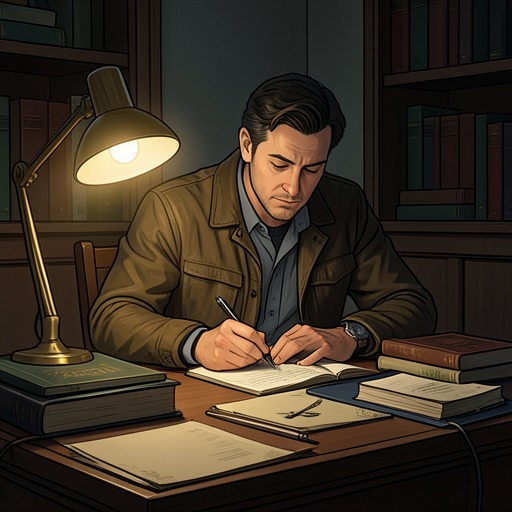
Martin Eden’s alienation from both working-class and bourgeois society
Martin EdenMartin Eden’s alienation is not merely the rejection of a man who has fallen out of favor. It becomes a condition of having no social world he can re-enter: the working-class life he has left feels foreign, the bourgeois world that once seemed desirable cannot understand him, and public fame turns his name into an image detached from the person who lived it. The more he learns and achieves, the less able he is to belong.
Public Scandal and Family Estrangement
After a newspaper misrepresented his speech at a socialist meeting, the consequences reached into Martin Eden’s ordinary neighborhood life. A Portuguese grocer stopped extending him credit; an American greengrocer, calling him a traitor, cancelled his account and refused even to let him repay what he owed. Neighbors shared the indignation, while children who had once been awed by the grand carriage that visited him now shouted insults from a safe distance. Maria remained loyal, and her children defended Martin in fights that left black eyes and bloody noses, bringing her further trouble.
The scandal also sharpened a rift within Martin’s family. Meeting Gertrude in Oakland, he learned that Bernard Higginbotham was furious about the family’s public disgrace and had forbidden him to come to the house. Gertrude urged him to leave, find work, and return after the anger had passed; she offered him money, which he declined, although he knew he would soon have to visit the pawnbroker. Her proposed future was practical and conditional: after a few months, Bernard might let him drive a delivery wagon. Her care did not remove the distance between them.
The Intellectual Chasm
Martin cannot explain why he will not simply get a job. To Gertrude and the people around him, steady work is the obvious answer to disgrace and hardship; to him, their advice reveals how far apart their assumptions have become. He thinks of their entire vocabulary of right conduct as exhausted by the demand to work, and sees their attachment to a job as a submission to the very condition that confines them. His judgment is severe, but the scene also shows the isolation produced by his convictions: he has no language he believes can make his position intelligible to his family.
The divide is not just a disagreement about politics or employment. Martin understands it as an intellectual gulf he cannot cross, shaped by the Nietzschean position he holds in relation to socialism and by his sense that the people closest to him lack the concepts needed to understand his choices. He shakes his head rather than explain. The silence preserves his independence, but it also leaves him alone with an understanding of himself that he cannot share.
No Return to the Former Life
An encounter with Lizzie Connolly briefly draws Martin back among the young companions of his earlier days. A fight breaks out around a moving streetcar, and he feels the old excitement of combat return. It fades quickly. He feels centuries older than the carefree young people around him and finds their beer and companionship as raw as a life he has outgrown. The books through which he has travelled now seem to stand between him and his former companions like an unbridgeable distance.
Martin’s estrangement extends beyond the working-class gang. He feels that his own family cannot understand him, that the bourgeoisie cannot understand him, and that Lizzie, whom he honors, cannot understand either his regard for her or the meaning he gives it. At their parting, he advises her to make peace with the young man whose place he had taken that day. Lizzie says she cannot do so now. The moment offers no new attachment to replace what Martin has lost: he recognizes his need for companionship, yet finds no community in which it can be satisfied.
Fame Without Belonging
Public recognition does not close the gap. As Martin’s writing becomes famous, he sees the celebrated author as a figure produced by the crowd rather than as himself. The magazines publish portraits he can no longer associate with his identity. He recognizes himself instead in the sailor who served in the forecastle, the young man stunned by the library’s thousands of books, and the writer who stayed up late to make books of his own. The famous name seems to him a public appetite fed by the crowd, not a truthful account of the person whose life preceded the acclaim.
This estrangement is especially stark because Martin had once imagined the first-class world as a kind of paradise. Aboard ship, now travelling first class, he tries to find kinship among the sailors in the forecastle and encounters men he regards as dull and bestial. He also finds the first-cabin passengers and their energetic young companions intolerable, despite acknowledging that they are good and kindly people. The contrast between his former place below deck and his present position at the captain’s right hand brings no satisfaction: he cannot recover the old life, and the privileged life he once envied does not become a home.
Isolation and the Approach of Death
By the time Martin recognizes that he is in the Valley of the Shadow, alienation has become bound up with exhaustion and a fading desire to live. He sleeps more, resents being awakened, and experiences conscious life as painful rather than sustaining. His thought of leaving for the South Seas and preparing for that journey offers a way out of his immediate surroundings, but the deeper problem remains: he has not found a new community to replace the ones from which he feels exiled.
The novel thus presents Martin’s isolation as both social and inward. Public hostility, family estrangement, class divisions, and the loss of his former companions all contribute to it, while his own intellectual development makes return increasingly impossible. Fame intensifies the paradox rather than resolving it: everyone can recognize the celebrated author, but Martin cannot recognize himself in the figure they celebrate.